

Sponsored Link
By default ubuntu will come with vino-server so it is very easy to configure to enable remote desktop sharing in your ubuntu machine.If you want to access ubuntu machine remotely you need to login in to your ubuntu system.
Important note :-
Remote Desktop will only work if there's a GNOME login session.Leaving your computer with an unattended GNOME login session is not secure and not recommended.
Some Tips
1) You can lock your screen using System--->Quit

Once you click on quit you should see the following screen here you need to select lockscreen

2) switch off your monitor when computer is left unattended
Configuring Remote Desktop
First you need to go to System -> Preferences -> Remote Desktop

Once it opens you should see the following screen

In the above screen you need to configure remote desktop preferences for sharing and security
For Sharing
you need to tick the box next to the following two options
Allow other users to view your desktop
Allow other users to control your desktop
For Security
you need to tick the box next to the following two options
Ask you for confirmation (If you tick this option some one need to click on allow from remote desktop once it connected if you don't want you can untick this option)
Require the user to enter this password:
Password: Specify the password

Connecting from Ubuntu Machine
Open your terminal from Applications--->Accessories--->Terminal and enter the following command
vncviewer -fullscreen 192.168.2.23:0
now you should see the following message asking for password enter the password after complete success you can see VNC authentication succeeded message and starting remote desktop
VNC viewer version 3.3.7 -- built Jul 4 2006 10:04:48
Copyright (C) 2002-2003 RealVNC Ltd.
Copyright (C) 1994-2000 AT&T Laboratories Cambridge.
See http://www.realvnc.com for information on VNC.
VNC server supports protocol version 3.7 (viewer 3.3)
Password:
VNC authentication succeeded
If you want to quit vncviewer
Press ‘F8' and select Quit viewer
Connecting from Windows machine
If you are trying to connect from your windows machine you need to install vncviewer of your choice i have installed from here http://www.realvnc.com/download.html.Install this program once you install this you can opem from start--->All programs--->RealVNC--->VNC Viewer 4--->Run VNC Viewer once it opens you should see the following screen here enter the remotemachine ipaddress:0 format and click ok

Now it will prompt for password enter your password and click ok

Now on the remote machine you should see the following screen asking for permission to allow this connection you need to click on allow this will comeup only if you tick "Ask you for confirmation" option under sharing
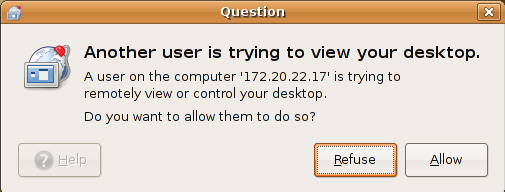
Once it connected you should see the remote machine desktop like the following screen
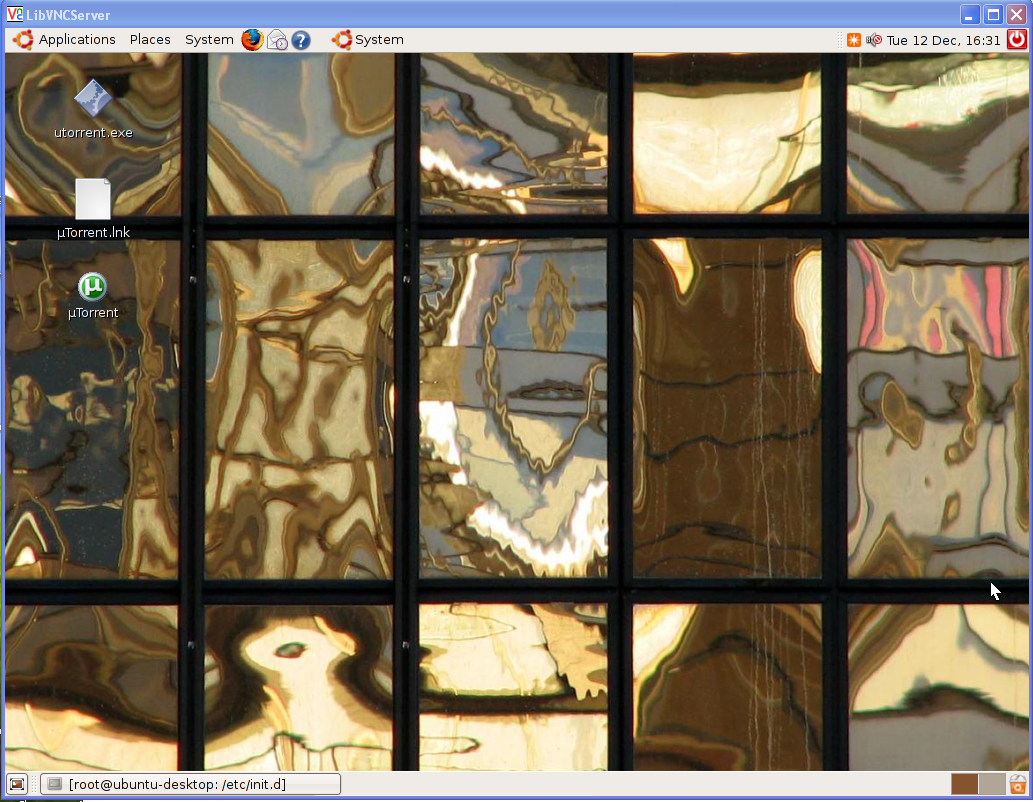
I tried the vnc solution built into 9.10 and just wasn’t happy with performance and the fact that if I logged out I was screwed.
I tried the NXclient that someone suggested and wow, very nice–easy to setup even with all my composting effects turned on and across a VPN connection.
Great post, within KDE you can use Krfb which runs within the same setup and allows for users to gain access via VNC and also control your desktop :).. I am a kubuntu user so not sure if that helps anyone else…
Also you will need to check your emails being sent out, because it will use the local LAN IP and not your remote one (ISP one)..
That last image is 1meg in size – you could probably save a bit of bandwidth by reducing it to a tenth that size.
This worked great for me on Mint 8. Thanks for the help! I can’t believe how easy it was to set up!
Do i substitute the loca ip for the exter ip if I want to traverse the internet. Would I need to punch wholes in the fire wall.
thank you!
I love your articles.
Yes you would need to use the external IP, because your local IP is only visible from the local network..
as for opening ports, If I remember right if you should configure TCP connections to ports 5900 and 5800 , then open remote desktop preferences and it should say your visible from the net…
as for firewall you should be fine, I don’t thing it needs to be touched.
I connect externally and I didn’t touch my firewall.
I didn’t open any ports on my router – and it seems to work fine.
I don’t have a fixed IP address, however. Are there any solutions to that problem?
DynDNS
grdc is fastest and the best.
I have tried this and it was a little bit slower for me. I want to find out if this was just my internet connection.
Is there a way to listen to the music from the computer you control?
@Jeff:
My ubuntu desktop controls my stereo.
I use mpd. From other nodes on my local network I use various clients, including gmpc.
There is even a client for the iphone.
hey. i tried to access my ubuntu desktop from a windows xp with, machine.
but the screen doesn’t change on VNC viewer if i made some changes.
for example if i right click, the nautilus menu doesn’t appeear on my vnc viewer.
if i open some application it doesn’t appear on my vnc viewer
I have the same problem (I think) as does znupii. I see the desktop on vnc viewer but it does not change , more like a fixed graphic of what my ubuntu box has. Mouse works, I can see it selecting items etc via vnc but the opening windows do not show on the remote side. What needs fixing?
VNC is not working anymore. It has a bunch of problems with new composited desktops, If you terminate your compiz whenever try to connect remotely you may involved with a bunch of other problems, keyboard may not working, Titlebars may hide, and so on, if you try to run it near compiz, you will get involved with tones of bash commands to run and after all, it will be all by chance to get it work or not (mine is not working!)
Are there any protocols suitable for remote connecting to an ubuntu desktop?
Any helps appreciated:)
This method works well, but I feel like it might be too technical for some. I guess that’s what happens when you’re running Ubuntu, but regardless, I think in a business setting it is cost effective to use paid remote desktop software.. less downtime, less lost revenue.
@Daniel Lord:
This software works perfectly for personal use.
If you want to develop this for a business purpose, it’s more efficiently to use VPNs.
Almost all business applications are based on VPNs.
See more details here:
http://www.cisco.com/web/about/ac123/ac147/archived_issues/ipj_1-1/what_is_a_vpn.html
Good work!, Thanks a lot. It woked nice for me.
after entering the password in VNC viewer i don’t get the above shown dialog box that someone is trying to view your desktop how to enable this… i want my linux pc to be used by more than one users. please help me.
what are you trying to get out of your server..
from what I think your trying to do, you would be better off with ubuntu server, then creating multiple user/vnc accounts, then your able to all connect at once to your own personal desktop…
How do I share my desktop with a Windows user? I’m using Ubuntu 10.10.
in the vnc option under the misc tab, there is an option “”share desktop”” (do not disconnect other viewers)
If you select that check box, you should be able to both connect at the same time.
I do not think VNC rendering speed and quality over long hops is that good. YMMV of course! I use Xen desktops from home and on the move and I can say that the quality is much better.
Thanks, just didn’t know what to type as port. I don’t think :port has anything to do with the real port it is running on. Think it is tied to gnome session you are running, which I didn’t realize you needed to do. Like someone said earlier, pretty sure real port is 5900.
Still not got answer for. Once connected with VNC to Ubuntu 11.04. Why the resolution did not come same as your ubuntu desk 1024 X 768. If any graphics driver installed like ATA/NVIDIA than Why VNC mouse only work windows did not comes up things run to main system but did not get same screen refreshed on client. If you disconnect VNC and connect again you get the screen. so refreshing is not working after installing graphics driver. Please some one expert with ubuntu put some light on this. Help in need. Thank you.
xrdc – easy to use and faster…
I *hope* I never see a remote machine desktop like that one! >*_*<